 how-to
FMCG Bulk Supply for Remote Ghana Shops: 2026 Guide
Table of Contents
- Why FMCG Bulk Supply Matters for Remote Ghana Shops
- How to Choose and Verify FMCG Wholesale Suppliers in Ghana
- Order Minimums, Bulk Pricing, and Total Landed Cost
- Practical Delivery Logistics for Remote Shops
- Rural Payment and Credit Options for Bulk Orders
- Shop Restocking Checklist: A Step-by-Step Guide
- How to Prevent Stockouts in Retail
- Expiry Date Management for Retailers
- Frequently Asked Questions
Last Updated: October 16, 2026
Why FMCG Bulk Supply Matters for Remote Ghana Shops
FMCG bulk supply is the practice of buying fast-moving consumer goods in large quantities from wholesalers, then distributing them to retail outlets at a lower unit cost. For remote Ghana shops, it is often the difference between a stocked shelf and an empty one.
The math is unforgiving. A shopkeeper in Koforidua who buys a single carton of soap from a nearby kiosk pays more per bar than one who orders twenty cartons from a wholesale distributor. That gap eats directly into margins.
Buying in bulk solves both problems at once. It lowers your cost per unit and gives you enough buffer to keep serving customers between deliveries. The challenge is doing it without tying up cash you need elsewhere or ending up with expired goods on your shelves.
This guide covers how to find reliable FMCG wholesale suppliers in Ghana, how to verify them, what to expect on order minimums and landed cost, and how to plan restocking so you never run dry. Below, we walk through each step with practical detail you can act on this week.
How to Choose and Verify FMCG Wholesale Suppliers in Ghana
The best way to choose an FMCG wholesale supplier in Ghana is to verify three things before you place a first order: business registration, physical stock, and delivery track record. Skip any one of these and you are gambling with your capital.
A common mistake is trusting a supplier because they answered quickly on WhatsApp. Anyone can send a price list. What matters is whether they can actually deliver the goods you paid for, on the date they promised, to your location.
Here is how to vet a new supplier:
- Ask for a business registration certificate. A legitimate wholesaler registers with the Registrar General's Department. If they hesitate, move on.
- Request a video call showing their warehouse. You want to see actual stock, not a photo that could be years old.
- Order a small trial batch first. Pay for a modest order and see how they handle it before committing to a large one.
- Get two references from shops in your region. Ask those shops directly how the supplier performed.
- Confirm their return policy in writing. What happens if goods arrive damaged or short?
The Registrar General's Department business registration portal lets you confirm whether a company is properly registered. It takes a few minutes and can save you from a costly mistake.
Once a supplier passes these checks, keep the relationship. Reliable FMCG wholesale suppliers in Ghana are not abundant, and switching costs you time and trust.
Order Minimums, Bulk Pricing, and Total Landed Cost
Order minimums, bulk pricing tiers, and total landed cost are the three numbers that decide whether a bulk order actually saves you money. Most shopkeepers track the first two and ignore the third. That is a mistake.
Order minimums vary widely. Some wholesalers set a minimum by value, others by carton count, and some by product category. A supplier might require a minimum order value before they will deliver to your area, or a minimum number of cartons per product line.
Bulk pricing usually works in tiers. The more you buy of a single item, the lower the unit price. But the cheapest tier is not always the right one. If you buy more than you can sell before expiry, you have not saved money, you have bought waste.
Total landed cost is where the real calculation happens. It includes:
| Cost Component | What to Include | Why It Matters |
|---|---|---|
| Unit price | Price per item at your chosen tier | Sets your baseline |
| Delivery fee | Transport to your shop | Can erase bulk savings if high |
| Payment charges | Any fee on mobile money or transfer | Small but recurring |
| Breakage and spoilage | Expected loss in transit or storage | Often overlooked |
| Storage cost | Space and conditions you provide | Real cost for perishables |
Add these together, then divide by the number of sellable units. That is your true cost per item. Compare that to your current supplier's price. Only then do you know if you are actually saving.
For remote shops, delivery is usually the largest variable. A supplier with a slightly higher unit price but free or low-cost delivery to your area can beat a cheaper supplier who charges heavily for transport. Run the numbers both ways before you decide.
Practical Delivery Logistics for Remote Shops
Reliable delivery is the hardest part of FMCG bulk supply for shops outside Accra and other major cities. A supplier can have perfect pricing and still fail you if they cannot get goods to your door on schedule.
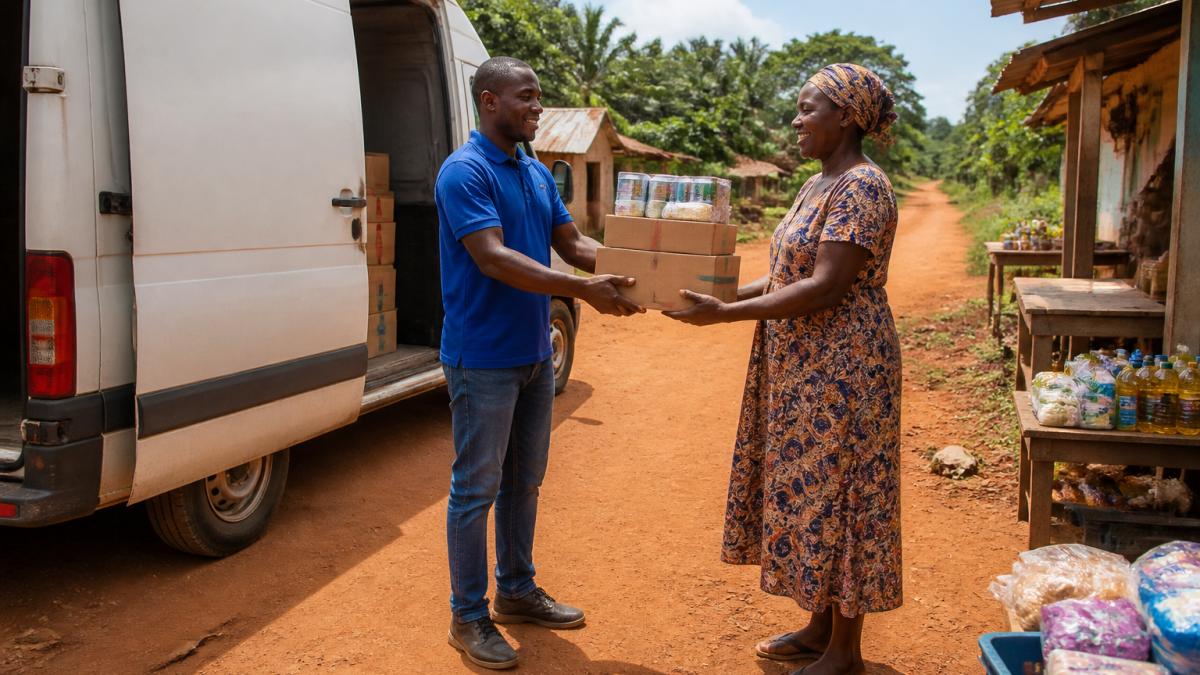
The delivery question comes down to a few practical points. Does the supplier deliver to your district at all? How often do their routes run? Do they deliver to your shop or only to a nearby town? What happens if a delivery is delayed?
A common mistake is assuming that because a supplier delivers "nationwide," they deliver to your specific location on a predictable schedule. Nationwide often means "we can arrange it," not "we come every week."
When you evaluate a supplier, ask:
- Which days do your vehicles pass through my district?
- Is delivery to my shop door, or do I collect from a depot?
- How much notice do you need for an order?
- What is your process if a delivery is delayed or a vehicle breaks down?
For very remote locations, some shops combine orders with neighbouring businesses to make a delivery worth the supplier's trip. This can lower your delivery cost and give you more negotiating power.
Rural Payment and Credit Options for Bulk Orders
Payment flexibility matters as much as delivery when you are ordering in bulk from a rural location. Most wholesalers now accept mobile money, which removes the need to travel to a bank or carry large amounts of cash.
Mobile money has become the default payment method for many small businesses in Ghana. It is fast, traceable, and works from anywhere with network coverage.
Bank transfer is another option, though it can be slower for rural customers and may require a trip to a branch. Cash on delivery is still offered by some suppliers, but usually only for established customers or smaller orders.
Credit terms are the most valuable and hardest to get. A supplier who will let you pay for part of an order now and the rest after you sell the goods is effectively financing your inventory.
New customers rarely get credit immediately. The usual path is to place several prepaid orders, pay on time, and then ask.
Keep a simple record of every payment you make. If you ever need to dispute a charge or prove you paid, that record is your evidence.
Shop Restocking Checklist: A Step-by-Step Guide
A shop restocking checklist keeps you from ordering on impulse and ending up with the wrong mix of goods. The goal is to restock based on what actually sells, not on what looks good in a catalogue.
Use this checklist each time you prepare a bulk order:
- Count current stock of your top twenty selling items
- Note which items are below two weeks of cover
- Review last month's sales to spot fast movers and slow movers
- Check expiry dates on existing stock and prioritise older items
- Calculate a realistic order quantity for each item
- Confirm your total order meets the supplier's minimum
- Check delivery date against your remaining stock
- Confirm payment method and any fees
- Record the order details and expected delivery date
- Plan shelf space and storage for the incoming goods
The most important step is the first one. Counting stock takes time, but ordering blind is how shops end up with too much of one thing and none of another.
How to Prevent Stockouts in Retail
Preventing stockouts in retail comes down to knowing your reorder point for each product and ordering before you hit it. A stockout costs you the sale, and often the customer, who may not come back.
The reorder point is the stock level at which you place a new order. It should account for how long delivery takes and how much you sell in that period.
Many shopkeepers order when they run out, not before. That guarantees a gap. Order when you still have enough stock to cover the delivery window.
A simple way to manage this without software is to mark a reorder line on the shelf itself. When stock drops to that line, you order. It takes discipline, but it works.
Track your fast movers separately. These are the items that sell out fastest and cause the most damage when they are missing. Give them a higher safety buffer than slow-moving items.
Review your reorder points every few months. Sales patterns change with seasons, school terms, and holidays. A point that worked in January may be wrong by June.
Expiry Date Management for Retailers
Expiry date management is the practice of tracking and rotating stock so that older items sell first and nothing expires on your shelf. For FMCG retailers, expired stock is pure loss.
The rule is simple: first in, first out. New stock goes behind or under older stock, never in front of it. This applies to every shelf and every storage area.
Check expiry dates when goods arrive, not months later. If a supplier sends short-dated stock, you need to know immediately so you can raise it with them. Some suppliers will replace short-dated goods if you flag it on delivery.
Keep a simple expiry log for perishable and short-dated categories. Note the product, quantity, and expiry month. Review it weekly and discount or move items that are approaching their date.
For remote shops, this matters more, because you may not be able to return goods easily. Check on arrival, and negotiate a replacement policy with your supplier before you order.
Running a remote shop in Ghana means juggling delivery delays, tight margins, and the constant risk of running out of your best sellers. Bundle Buy Ghana is your premier destination for wholesale and retail FMCG goods, serving both businesses and homes across the nation.
Frequently Asked Questions
How can small shops in remote Ghana restock FMCG products?
Small shops can restock by ordering from FMCG wholesale suppliers in Ghana that offer nationwide delivery. Use a shop restocking checklist to plan orders, and choose suppliers with reliable delivery to remote areas. Mobile money payments simplify transactions. Bundle Buy Ghana provides bulk supply with delivery across Ghana, including remote locations.
What FMCG products should a small shop keep in stock?
Focus on fast-moving consumer goods like rice, cooking oil, sugar, milk, soap, detergent, and canned foods. These items have consistent demand. Track sales to identify which products sell fastest in your area. A balanced inventory includes staples, snacks, and household essentials. Avoid overstocking slow movers.
Is buying FMCG in bulk cheaper for small shops?
Yes, bulk buying typically lowers unit costs. However, consider total landed cost: product price, delivery fees, and any mobile money charges. Ordering larger quantities reduces per-item cost but ties up capital. Calculate your storage capacity and sales velocity before committing to large orders.
What should retailers check before choosing a wholesale supplier in Ghana?
Verify the supplier's registration, ask for references from other retailers, and confirm delivery reliability to your area. Check product quality and expiry dates. Understand minimum order quantities and payment terms. Bundle Buy Ghana offers verified FMCG wholesale supply with mobile money and nationwide delivery.