 blog
blog
Best Wholesale Distributors for Small Businesses
Table of Contents
- What Small Businesses in Ghana Should Expect From Wholesale Distributors
- How to Find Wholesale Suppliers for a Small Business
- Wholesale Minimum Order Quantity: What Small Shops Can Realistically Manage
- Wholesale Pricing for Small Businesses: Landed Cost and Margin Basics
- A Practical Wholesale Supplier Checklist for Ghanaian Retailers
- Domestic vs International Wholesale Distributors: Which Fits Your Shop?
- Common Mistakes Small Businesses Make When Choosing Wholesale Distributors
- Conclusion: Building a Wholesale Supply Chain That Grows With Your Shop
- Frequently Asked Questions
Last Updated: October 12, 2026
What Small Businesses in Ghana Should Expect From Wholesale Distributors
Wholesale distributors are the businesses that buy fast-moving consumer goods in bulk from manufacturers or importers and resell them to retailers, minimarts, supermarkets, and online resellers at trade prices.
The market has changed. Shop owners who once walked through Accra's big trading hubs every week now expect structured supply: clear price lists, predictable delivery windows, and invoices they can plan around.
The Shift From Market Runs to Structured Wholesale Supply
Market runs gave small retailers flexibility, but they also carried hidden costs: transport, time, and inconsistent stock.
Structured wholesale supply replaces guesswork with a repeatable process. You order from a product catalog, agree an opening order, and receive goods on a schedule.
The payoff is real. A shop that knows its lead time can keep fast sellers in stock and stop tying up cash in slow movers.
How to Find Wholesale Suppliers for a Small Business
Finding wholesale suppliers for a small business starts with matching the supplier's product range to what your customers actually buy, then verifying the business is real before you send money.
A common mistake is chasing the lowest unit cost and ignoring everything else. A supplier who is cheap but delivers late will cost you more in lost sales than you saved on the order.
Here is how we would approach it:
- Start with the categories that turn over fastest in your shop
- Ask other retailers which trusted vendors they reorder from
- Check whether the supplier publishes a clear product catalog and pricing
- Request a sample order before committing to a large opening order
- Confirm the supplier's registration and physical address
- Compare at least three suppliers on price, lead time, and delivery terms
Wholesale Minimum Order Quantity: What Small Shops Can Realistically Manage
A wholesale minimum order quantity (MOQ) is the smallest order a supplier will accept, and it is the single number that decides whether a small shop can access trade pricing at all. Most small retailers assume they are too small for wholesale. In practice, minimums vary so widely that the real skill is reading how a supplier structures its MOQ, not just what the number is.
The Four Ways Suppliers Set Minimums
Two suppliers can both advertise "MOQ: 50" and mean completely different things. Before you compare, identify which structure you are dealing with:
- By value. A supplier may require a minimum order value (for example, a set opening order amount) rather than a unit count. This is the friendliest structure for a small shop because you choose the mix.
- By carton or case. You must buy full cases, so the effective minimum is carton size × number of cartons. A low carton count can still be expensive if each carton holds slow-moving stock.
- By SKU. Some suppliers require a minimum number of units per product line. This forces you to spread cash across many items, which is risky if you have not tested demand.
- By pallet or layer. Common with importers and large FMCG distributors. This is usually out of reach for a single small shop and is where order-splitting or a buying group becomes necessary.
What Minimums Mean for Your Cash, Not Just Your Shelf
The number that matters is not the MOQ itself, it is the cash it locks up before you sell a single unit. A useful rule of thumb: your opening order should not consume more cash than you can comfortably replace within one full sell-through cycle of your fastest-moving category.
Work it through with your own numbers:
- Estimate how many units of a product you realistically sell per week.
- Multiply by the supplier's lead time in weeks to get the stock you need to cover demand between orders.
- Compare that figure to the MOQ. If the MOQ is far above your lead-time demand, you will be sitting on dead stock, either negotiate, split the order, or walk away.
This is why a supplier with a slightly higher unit price but a minimum you can actually turn over often beats a cheaper supplier whose MOQ traps your cash.
Practical Ways to Meet a Minimum You Cannot Afford Alone
If a supplier's opening order is beyond your budget, you have more options than most shop owners realise:
- Combine an order with a neighbouring shop and split the goods and the invoice proportionally.
- Start with a narrower range and reorder more frequently instead of buying deep on every SKU.
- Ask whether the minimum applies per order, per quarter, or per year. Some suppliers will accept a smaller first order if you commit to a reorder schedule.
- Ask about a trial or sample order that sits below the standard MOQ. Many distributors will do this for a first-time buyer.
- Look for suppliers that serve both wholesale and retail buyers, since their wholesale tier often has a lower entry point.
- Time your order around promotions. Some suppliers lower the effective minimum during slow seasons or on clearance lines.
The right minimum is one you can meet without borrowing, without overstocking, and without tying up cash you need for your fastest sellers. If a supplier's MOQ fails that test, it is the wrong supplier, no matter how good the unit price looks.
Wholesale Pricing for Small Businesses: Landed Cost and Margin Basics
Wholesale pricing for small businesses only makes sense once you calculate landed cost, not just the unit price on the invoice.
Landed cost is everything you pay to get goods onto your shelf: the unit cost, delivery, any transport you arrange, and the cost of damaged or short-delivered items.
| Cost Element | What to Include | Why It Matters |
|---|---|---|
| Unit cost | Price per carton or piece | The starting point, not the full picture |
| Delivery | Transport to your shop | Can erase a "cheap" price advantage |
| Lead time | Days from order to arrival | Longer waits mean more stock tied up |
| Shrinkage | Damaged or short items | Quietly raises your real cost per unit |
| Payment terms | Cash, transfer, or mobile money | Affects your cash flow, not your margin |
Once you know landed cost, set your retail price to protect a margin that covers rent, staff, and spoilage.
A Practical Wholesale Supplier Checklist for Ghanaian Retailers
A wholesale supplier checklist turns a gut-feel decision into a repeatable test, so you judge every supplier the same way.
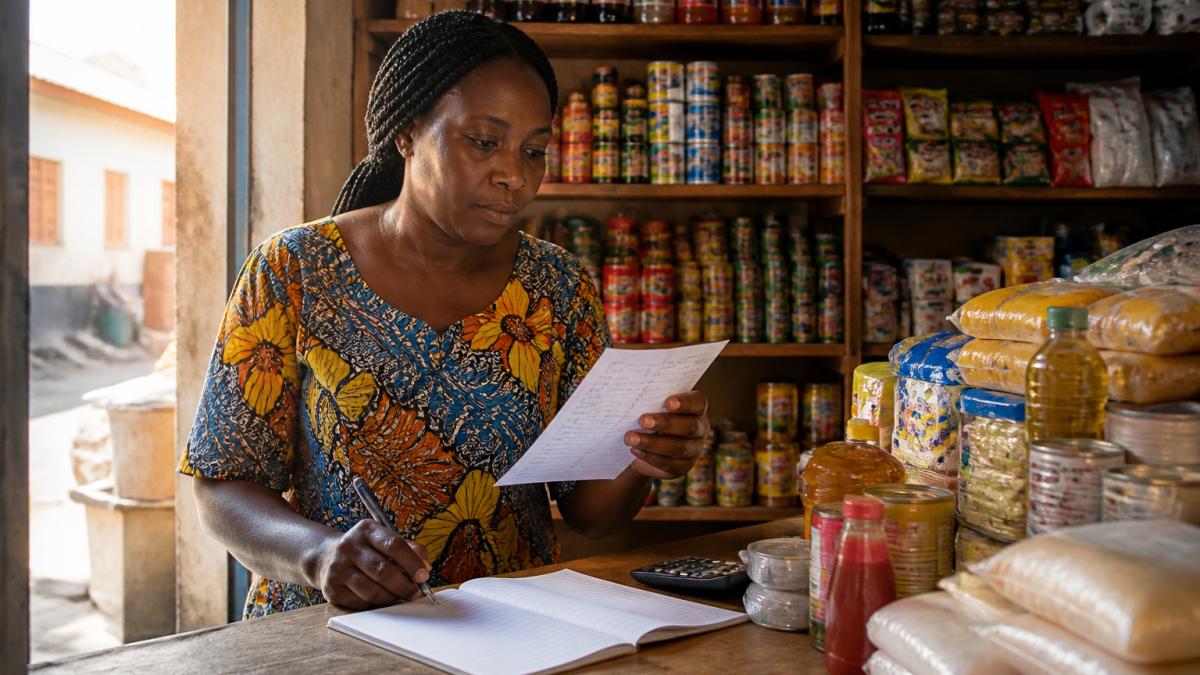
Use this before you commit to any opening order:
- Business registration and a verifiable physical address
- A clear product catalog with published or quoted pricing
- Minimum order quantity you can meet comfortably
- Delivery coverage for your area, with a stated lead time
- Payment terms you can work with, including mobile money
- A written return policy for damaged or wrong items
- At least two references from retailers who reorder regularly
- A trial sample order before a large commitment
Domestic vs International Wholesale Distributors: Which Fits Your Shop?
Domestic wholesale distributors usually win for small shops because they offer shorter lead times, easier returns, and no import paperwork, while international sourcing can lower unit cost on larger volumes. That is the headline. The decision, however, comes down to four operational differences that quietly determine whether overseas sourcing saves you money or sinks your cash flow.
The Four Differences That Actually Decide It
1. Lead time and cash-flow drag. Domestic suppliers typically deliver in days, so your cash cycles quickly. International sourcing adds production time, freight, and customs clearance, stretching the gap between paying and selling.
**2.
3. Quality control and returns. With a domestic supplier, a damaged or wrong item is usually a phone call and a replacement.
4. Import obligations. International sourcing brings customs documentation, duty classification, and clearance procedures that a domestic purchase does not.
A Simple Decision Framework
Choose domestic supply when:
- You need fast, repeatable replenishment of fast-moving goods
- Your order volumes are modest and your cash is tight
- You want simple returns, local support, and no import paperwork
- Your customers expect consistent availability week to week
Consider international sourcing when:
- You can commit to large volumes that justify the freight and duties
- Your margins can absorb the extra landed cost and a defect allowance
- You have a reliable way to clear goods and inspect quality
- The product is not time-sensitive and can sit in transit without hurting sales
A Middle Path Most Guides Ignore
You do not have to choose one model for your whole shop. A common pattern among small retailers is to source fast-moving, high-frequency categories domestically for reliability, and to import slower, higher-margin or differentiated lines where the unit-cost saving is large enough to justify the lead time. This hybrid approach keeps your shelves full while capturing overseas savings where they actually matter.
Common Mistakes Small Businesses Make When Choosing Wholesale Distributors
The most damaging mistake is choosing a supplier on price alone and ignoring reliability, lead time, and return terms.
Other costly errors we see often:
- Skipping the sample order and committing to a full opening order
- Failing to confirm the supplier's registration and address
- Ignoring delivery costs when comparing unit prices
- Assuming a low minimum means low quality
- Not asking about the return policy until something goes wrong
- Relying on a single supplier with no backup
Conclusion: Building a Wholesale Supply Chain That Grows With Your Shop
Stockouts and overstocking are the two ways small shops lose money, and both come down to the supplier you choose. Bundle Buy Ghana is your premier destination for wholesale and retail FMCG goods, serving both businesses and homes across the nation. With our reliable nationwide delivery and convenient mobile money payment options, we make bulk buying simple, efficient, and accessible for everyone.
Frequently Asked Questions
What should a small business look for in a wholesale distributor?
Focus on four things: reliable delivery to your location, transparent pricing with no hidden fees, a minimum order quantity you can afford, and a clear returns policy for damaged goods. Ask for a sample order first to test product quality and lead time. A distributor that communicates well before you pay is likely to communicate well after.
How do I find a wholesaler for my business in Ghana?
Start with trade associations and local market clusters, then check online B2B platforms and supplier directories. Ask other shop owners in your area who they buy from. When you find a candidate, request a product catalog, confirm their minimum order quantity, and place a small sample order before committing to bulk purchasing. Reliable suppliers will welcome the test.
Do wholesale distributors have minimum order quantities?
Most do, but the amount varies widely. Some set minimums by total order value, others by units per product. For small shops, look for distributors with low opening order requirements or mixed-pallet options. If a minimum is too high, ask whether you can combine categories to reach it, or start with a smaller trial order to build trust.
What payment and delivery options should I compare when buying wholesale in Ghana?
Compare mobile money versus bank transfer fees, delivery timelines to your specific area, and whether the distributor charges for returns. Nationwide delivery matters if you are outside Accra. Confirm lead time in writing before you order, and check whether the distributor offers flexible pricing tiers as your order volume grows.